
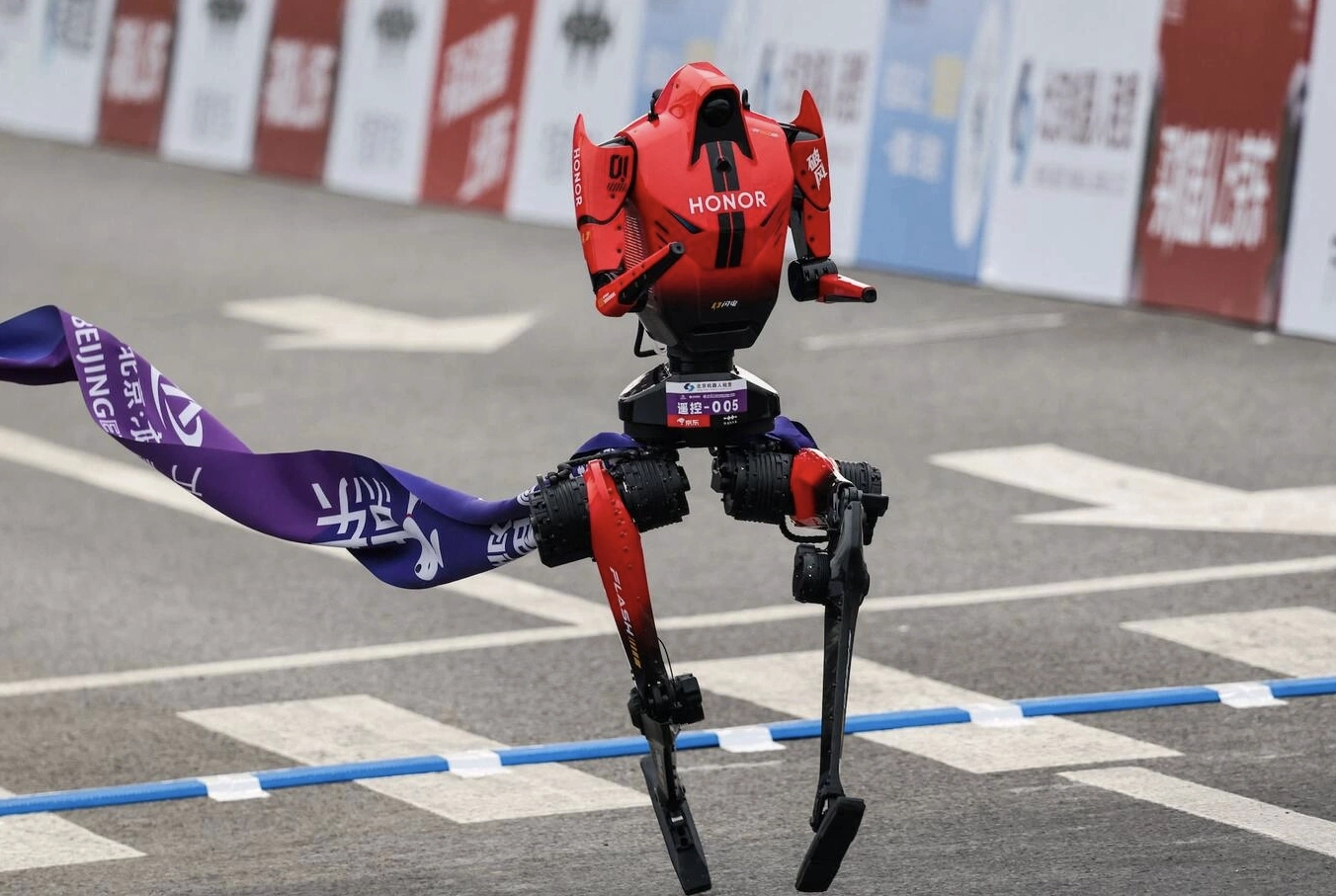
The result capped a remarkable improvement during the competition. Tiangong Ultra opened the event with a 9.39-second run on August 22, later improved to 8.86 seconds, and then lowered the Games record again to 8.64 seconds in the final on August 26.
Tiangong Ultra was developed by the Beijing Humanoid Robot Innovation Center, also known as X-Humanoid. Its performance highlights how quickly Chinese developers are advancing locomotion, motor control, balance and high-speed movement in humanoid machines.
The comparison with Bolt is striking, although the two performances should not be treated as equivalent athletics records. Robot races operate under different rules and starting conditions and are not certified by World Athletics. Bolt's 9.58-second mark, set at the 2009 World Championships in Berlin, therefore remains the official men's human 100-meter world record.
Tiangong Ultra cuts its 100-meter time dramatically
The pace of improvement may be even more significant than the headline record. At the inaugural World Humanoid Robot Games in 2025, Tiangong Ultra completed the 100 meters in 21.50 seconds. One year later, the robot managed the same distance in just 8.64 seconds.
During the early stages of this year's competition, Tiangong Ultra initially trailed Lightning, a humanoid robot developed by smartphone maker Honor, before gaining ground later in the race. Lightning completed one of the preliminary 100-meter runs in 9.47 seconds and had previously recorded 9.32 seconds during a pre-event test.
High speed, however, remains only one part of the engineering challenge. After crossing the finish line, several robots struggled to slow down safely. Tiangong Ultra ran into protective padding after one of its high-speed attempts, while Lightning also lost stability after finishing.
The incidents highlight an important distinction for the humanoid robotics industry. Accelerating quickly in a straight line is becoming increasingly achievable, but reliable braking, balance recovery and safe operation around people remain much harder problems.
Those capabilities are especially important as robotics companies move beyond demonstrations and toward machines designed for practical work. Figure AI, for example, recently introduced Helix 02, a neural system intended to combine humanoid locomotion and object manipulation within a single control architecture.
More than 2,000 robots competed in Beijing
According to official data, the second World Humanoid Robot Games were held in Beijing from August 22 to 26 and brought together 2,056 robots from 666 teams representing 16 countries.
The machines competed across dozens of events, ranging from sprinting, football and table tennis to challenges designed around practical applications such as industrial operations, household tasks and emergency-response scenarios.
The broader event illustrates how humanoid robotics is evolving beyond spectacular demonstrations. Developers are increasingly testing whether robots can perform complex movements, interact with their surroundings and complete tasks that could eventually be useful in factories, warehouses and service environments.
China is accelerating humanoid robot development
China has identified humanoid robotics as an emerging strategic industry and is investing heavily in artificial intelligence, motors, sensors, batteries and other technologies required to make general-purpose robots more capable.
The country's robotics companies are also attracting growing investor attention as expectations rise for commercial deployment in manufacturing, logistics and consumer services.
Unitree, one of China's best-known manufacturers of humanoid and quadruped robots, has become a prominent example of the sector's expansion. The company had already scaled production significantly after reporting deliveries of more than 5,500 humanoid robots in 2025.
The strong interest in humanoid systems reflects expectations that advances in AI could allow robots to perform a much wider range of physical tasks instead of being programmed for a single repetitive operation.
Humanoid robots are also improving over longer distances
Progress is not limited to short-distance sprinting. Tiangong Ultra previously won the world's first half-marathon specifically organized for humanoid robots in Beijing in 2025.
Honor's Lightning has also demonstrated strong endurance performance. At the 2026 Games, the robot completed the half-marathon in 50 minutes and 26 seconds.
For comparison, Uganda's Jacob Kiplimo set the official men's human half-marathon world record at 57 minutes and 20 seconds in Lisbon in March 2026. As with the 100-meter comparison, however, robot and human results are achieved under fundamentally different conditions and should not be treated as directly equivalent sporting records.
The latest World Humanoid Robot Games therefore demonstrate both the rapid progress and the remaining limitations of humanoid machines. Robots are becoming dramatically faster, but autonomous navigation, dexterity, balance recovery and safe interaction with unpredictable environments remain far more demanding challenges.
For the robotics industry, those capabilities will ultimately matter much more than whether a machine can complete 100 meters faster than the world's fastest human sprinter.
 ES
ES  EN
EN